CCSYR - Hire Skilled Women Returning to Work in York Region

Many mid-sized employers are trying to hire skilled people, but the right candidates just aren’t showing up. The few that do are quickly scooped up by bigger companies, leaving projects delayed and the team stretched thin. Roles stay open longer than planned, teams get burned out, and growth slows while recruiters cycle through the same limited candidate pools. At the same time, employers are expected to hire inclusively, onboard quickly, and ensure new hires are productive with minimal disruption.

There are solutions many employers overlook: hiring experienced professionals who’ve taken career breaks– often for caregiving or immigration reasons. This talent pool includes people with advanced degrees, specialized skills, and strong work ethic. They bring maturity, global perspective, and years of expertise. But they don’t always appear in traditional recruitment channels or fit neatly into traditional hiring pipelines because they have a gap on their resume. These candidates could be what you’re looking for.

From an operational standpoint, hiring people who have taken long breaks away from work and/or have spent most of their careers working in a different country certainly has its challenges. It’s tough for an employer to effectively integrate these employees into their existing teams and ways of doing things. Onboarding, training, mentorship, performance management… none of that is simple, quick or cheap. But with the right strategies in place, the investment can pay off through lower turnover, diverse perspectives, and access to a wider talent pool.

This blog will break down why more Ontario employers are turning to these kinds of hiring approaches to fill critical gaps, reduce recruitment pressure, and build stronger, more adaptable teams. You’ll learn the specific benefits, practical implementation strategies, and how to avoid common pitfalls.

Benefits to Hiring Women Returning From a Career Break
CCSYR - A Practical Guide for Employers in Canada - Infographic 2

1. Strengthens Your Diversity and Inclusion Strategy

Hiring women returning to work strengthens your company’s commitment to diversity and inclusion efforts. By focusing your talent search on this growing sedment of Ontario’s workforce, you can find qualified candidates who bring the proven benefits of diverse teams. Research consistently supports this approach. McKinsey’s 2020 study found that companies with above-average gender diversity were 25% more likely to have above-average profitability. Reports by other sector experts prove that more women and marginalized folks on your staff lead to more creativity, harmony, and financial gain.

2. Improves Your Employee Retention and Satisfaction

Women returning to the workforce after a career break are often looking for workplaces that offer flexibility, mentorship, and opportunities to grow. Making an effort to find and then support these candidates shows a commitment to employee well-being and professional development. When women feel supported during their transition, they’re much more likely to stay with your company long-term, which means better retention and a more stable and engaged workforce. Lower turnover means reduced recruitment costs and preserved institutional knowledge.

3. Enhances Your Employer Brand

How a company is perceived as an employer directly impacts its ability to attract top talent. By investing in women who are returning to work, you’re positioning your company as one that actively supports women’s career growth and work-life balance. This not only appeals to potential employees but also creates a positive impression with customers who value companies with social responsibility and inclusive business practices. In competitive markets in York Region, demonstrating this commitment can differentiate you from your competitors.

The Hidden Costs of Not Hiring Women Returning to Work

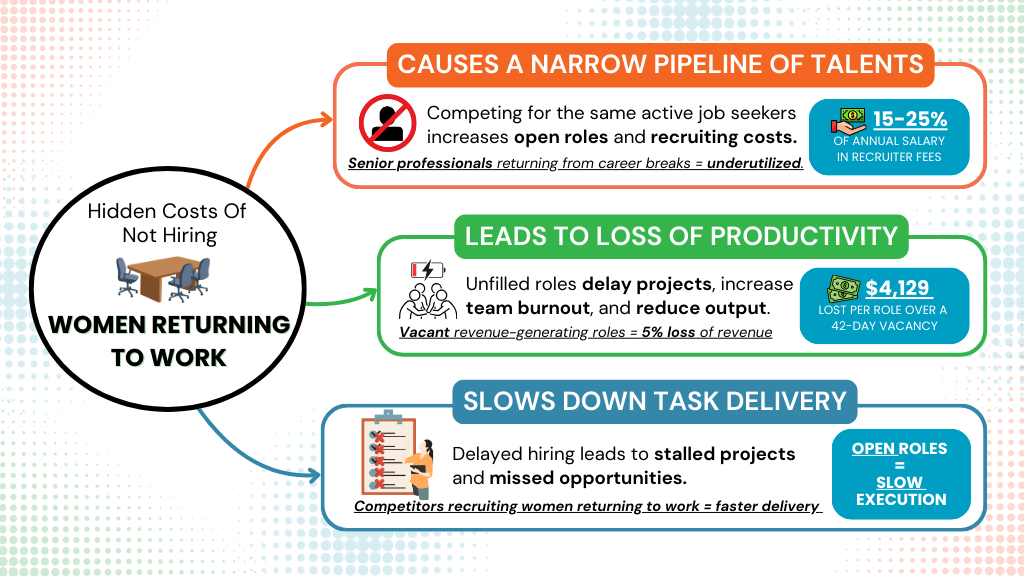
Most employers focus on what it costs to hire—recruiter fees, onboarding expenses, training time. But there's a bigger cost: what you lose by ignoring this talent pool.

1. Leads to Lost Productivity

Every month that a role stays unfilled costs you in lost productivity, delayed projects, and team burnout. Unfilled positions are estimated to cost companies an average of $4,129 over a 42-day vacancy period. The cost skyrockets when the open positions are for revenue-generating roles. Other research has found that leaving key sales roles vacant can reduce a company’s entire revenue by 5% or more.

2. Makes You Deal with Narrow Pipeline of Talents

When you're competing for the same limited pool of active job seekers with every other employer in York Region, roles stay open even longer. Recruiter fees at 15-25% of annual salary compound when you cycle through multiple searches. Meanwhile, experienced professionals who've taken career breaks aren't being actively recruited by most agencies—less competition means potentially faster hires.

3. Impacts Delivery of Tasks

There's also the competitive disadvantage. Projects get delayed because you don't have the people to execute them. Your competitors who are recruiting women returning to work are moving faster.

The calculation is straightforward: every qualified candidate pool you overlook makes hiring harder and more expensive. Expanding your search to include women returning from career breaks isn't just about inclusion—it's strategically smart.

When Career Gaps of Returners Signal Strength, Not Weakness

When people see a gap on a resume, the first reaction is often to wonder what’s missing. But time away from work can build skills that a straight, uninterrupted career never does.

Take someone who stepped away for five years to care for aging parents while navigating Canada’s healthcare and social services systems. That experience demands serious crisis management under constant pressure. You’re coordinating multiple providers, pushing through bureaucracy, juggling complex schedules, and making high-stakes decisions without perfect information. Those are the same skills you want in a strong operations manager or client services lead.

Or think about someone who immigrated to Canada and spent a couple of years getting established before returning to their field. They’ve shown real adaptability. Learning a new language, figuring out unfamiliar systems, building a professional network from scratch, and taking big personal risks all require comfort with ambiguity and change. That’s exactly the mindset you want in someone who can work across cultures and deliver results in shifting conditions.

Career breaks for health reasons tell a different but equally important story. They show self-awareness and the ability to set boundaries, which matter more and more as burnout becomes common. They also point to resilience, persistence, and a clear understanding of personal limits and strengths.

So the better question isn’t “Why is there a gap?” It’s “What did you learn during that time that makes you stronger now?”

When you look at career breaks this way, they stop being red flags. Instead, they become signs of transferable skills and lived experience that many other candidates simply don’t have. That shift can widen your candidate pool and surface people with genuinely different strengths.
Are you ready to make your workplace more inclusiveRead Our Practical Guide for Employers in Canada.

How to hire women returning to work

Hiring women who are returning to work after career breaks is not just about good intentions–it’s about putting the practical strategies in the right place, such as recruitment and onboarding.

For employers in the Greater Toronto Area, where competition for talent is intense and open roles can linger longer than planned, these approaches can help broaden the candidate pool without compromising day-to-day operational needs.

Here are several practical strategies tailored to employers who want to successfully recruit skilled women returning to work after career breaks:

1. Rewrite Job Postings with Returners in Mind

Use language that welcomes career breaks and focuses on skills and potential rather than uninterrupted tenure.

For example:

  • “Career breaks welcomed”
  • “Skills-based responsibilities”
  • “Flexible experience levels considered”

This signals inclusivity and attracts candidates who might otherwise self-select out.

2. Offer Flexible Work Arrangements

Flexibility can be a deciding factor for many returning professionals.

Options include:

  • Flexible start/end times
  • Hybrid or part-time schedules
  • Job sharing

Given commuting realities around the Greater Toronto Area, hybrid options can be especially attractive and help broaden your talent pool.

3. Build Structured Onboarding and Mentorship

A strong onboarding experience with role clarity and mentorship helps returners ramp up faster.

Best practices:

  • Assign a mentor for the first 3–6 months.
  • Provide a clear learning path with check-ins at 30/60/90 days.
  • Host welcome sessions that reintroduce company culture and tools.

This reduces integration friction and improves retention.

4. Train Hiring Managers on Inclusive Interviewing

Help hiring teams understand the value of lived experience and how to assess transferable skills. Cultural sensitivity training can support this.

Provide guidance on:

  • Avoiding bias around career breaks
  • Asking skills-focused interview questions
  • Valuing volunteer, freelance, or caregiving experience as real experience

This increases the likelihood of advancing strong candidates through the process.

5. Tap into Local Networks and Community Organizations

Connect with groups that support women’s re-entry to the workforce.

Greater Toronto Area has several resources:

Building these relationships expands your candidate sourcing beyond traditional recruitment channels.

Why Women Returners Leave in the First 90 Days (And How to Prevent It)

CCSYR - A Practical Guide for Employers in Canada - Infographic 1

Hiring women who are returning to work is often not the hardest part. Keeping them is where many employers run into trouble. When returners leave soon after joining, it’s usually for reasons that are predictable and preventable.

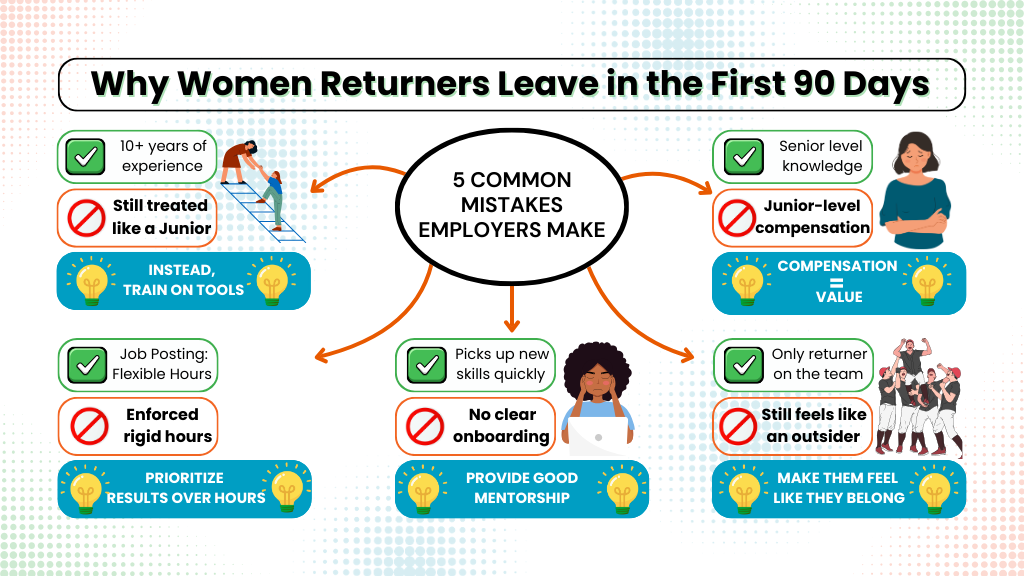
1. They were treated like junior employees despite senior experience.

A woman with 12 years of project management experience gets micromanaged simply because she hasn’t used your specific software. The assumption is that her career gap erased her expertise. It didn’t. She knows how to run projects. She just needs time to learn your tools. When her judgment isn’t trusted and she’s treated like a recent graduate, she’ll eventually leave for an employer who recognizes her real level of skill.

2. The flexibility you promised disappeared after the offer.

Your job posting said "flexible work arrangements." Then her manager expects her at her desk by 8:30 a.m. sharp every day and questions why she needs to leave at 4:45 p.m. twice a week. The disconnect between what you advertised and what you're actually offering becomes obvious fast.

3. There was no structured onboarding or mentorship.

You assumed someone with her experience would "just figure it out." Without a clear onboarding path and someone to answer questions, she spends weeks feeling lost. That's frustrating for someone who knows they're capable.

4. You undervalued her from day one.

You offered junior-level compensation because of the career gap. She accepted because she needed to restart her career, but felt undervalued from the beginning. When a recruiter calls offering market-rate pay three months in, she takes it.

5. She felt isolated in your workplace culture.

She's the only returner on a team where everyone else has linear career paths. Small comments land differently when you're already feeling like you have something to prove. She doesn't need special treatment, but she does need to feel like she belongs.

The fix is straightforward: match your actions to your stated intentions. Women returners who feel supported show exceptional loyalty. Women returners who feel misled leave fast– and they tell other candidates about their experience.

Frequently Asked Questions (FAQ) on Hiring Women Returning to Work

1. How do I assess skills when someone hasn't worked in 3-5 years?

Focus on transferable skills and use behavioral interview questions. Ask "Tell me about a time you coordinated multiple people with competing priorities" or "Walk me through how you'd approach this problem."

2. What if their technical skills are outdated?

Build time for upskilling into your onboarding plan. Offer real support through online courses, dedicated training time, internal sessions, or pairing them with a teammate. You’re not teaching them how to do the job. You’re helping them get up to speed on your specific tools.

3. How long does it take for someone to reach full productivity after a career break?

With a structured onboarding process, most women returning to work reach full productivity within three to six months. That’s about the same timeline as any new hire learning your systems and culture. How fast they ramp up has far more to do with the quality of your onboarding than the length of their career break.

4. What benefits or flexibility do women returning to work typically need?

The key is being clear about what ‘flexibility’ actually looks like in your workplace during recruitment, and then sticking to it. Flexibility also isn’t one-size-fits-all, so ask candidates directly during the hiring process. Common requests might include flexible start and end times to manage school schedules, hybrid work options, clear expectations around overtime, or advance notice for schedule changes. Others may care more about extended health benefits or access to professional development budgets.

5. What if they decide to leave again for family reasons?

All employees leave for different reasons, whether it’s a better opportunity, a move, a career shift, or family needs. Women returning to work who feel genuinely supported often show higher loyalty, because they remember the employer who gave them a fair chance.

Conclusion

York Region employers face real hiring challenges– roles staying open longer, talent being scooped up by bigger companies, and limited candidate pools. At the same time, it has a significant population of women who are ready to get back to work. They have taken breaks to care for their families or navigate a move to Canada from overseas. In returning to work they are offering to bring with them valuable skills, from their work years prior to their break, and through the experiences they have had while on break. These are intelligent, mature, and often worldly candidates who bring valuable perspectives, work ethic, and loyalty to employers who look beyond a resume gap.

The question isn't whether you can afford to hire women returning to work. It's whether you can afford not to, while your competitors access this talent and fill their roles faster.

Here’s how CCSYR can help.

For over 40 years, Catholic Community Services of York Region (CCSYR) has been helping newcomers and their families settle into Canadian life — which means we deeply understand the talent employers are missing. We work directly with skilled immigrants on credential recognition, language learning, and cultural adjustment. Through specialized workshops like EmpowerHER and Be Real Be Me, and our recently launched Women's Initiatives program, we support women's workforce re-entry, entrepreneurship, and professional development too! We provide business mentorship, emotional wellness support, and culturally responsive programming that prepares women to succeed in Canadian workplaces.

Besides, our Employment Services team connects prepared, qualified professionals—along with women returning to work and other overlooked candidates—with employers in the Greater Toronto Area who need them. We're not just a recruitment agency. We support both sides: candidates receive workforce preparation and cultural orientation, while employers receive diversity training, cultural competency workshops, and workplace integration support.

When you partner with CCSYR, you're accessing 40+ years of expertise in bridging the gap between exceptional talent and the employers who need it

Contact CCSYR Employment Services today to learn how we can help you.