Many mid-sized employers are trying to hire skilled people, but the right candidates just aren’t showing up. The few that do are quickly scooped up by bigger companies, leaving projects delayed and the team stretched thin. Roles stay open longer than planned, teams get burned out, and growth slows while recruiters cycle through the same limited candidate pools. At the same time, employers are expected to hire inclusively, onboard quickly, and ensure new hires are productive with minimal disruption.
There are solutions many employers overlook: hiring experienced professionals who’ve taken career breaks– often for caregiving or immigration reasons. This talent pool includes people with advanced degrees, specialized skills, and strong work ethic. They bring maturity, global perspective, and years of expertise. But they don’t always appear in traditional recruitment channels or fit neatly into traditional hiring pipelines because they have a gap on their resume. These candidates could be what you’re looking for.
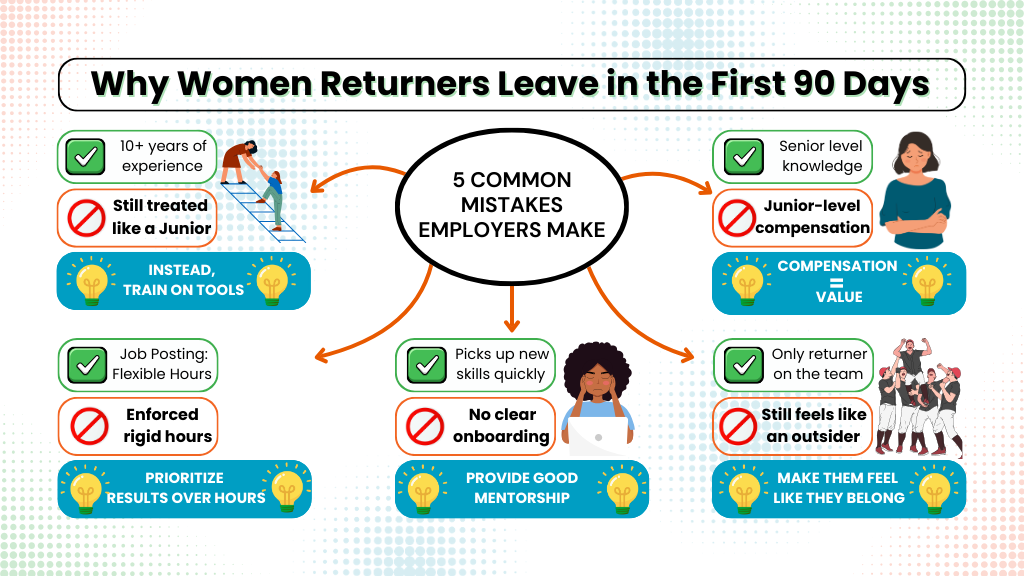
From an operational standpoint, hiring people who have taken long breaks away from work and/or have spent most of their careers working in a different country certainly has its challenges. It’s tough for an employer to effectively integrate these employees into their existing teams and ways of doing things. Onboarding, training, mentorship, performance management… none of that is simple, quick or cheap. But with the right strategies in place, the investment can pay off through lower turnover, diverse perspectives, and access to a wider talent pool.
This blog will break down why more Ontario employers are turning to these kinds of hiring approaches to fill critical gaps, reduce recruitment pressure, and build stronger, more adaptable teams. You’ll learn the specific benefits, practical implementation strategies, and how to avoid common pitfalls.
Benefits to Hiring Women Returning From a Career Break
1. Strengthens Your Diversity and Inclusion Strategy
Hiring women returning to work strengthens your company’s commitment to diversity and inclusion efforts. By focusing your talent search on this growing sedment of Ontario’s workforce, you can find qualified candidates who bring the proven benefits of diverse teams. Research consistently supports this approach. McKinsey’s 2020 study found that companies with above-average gender diversity were 25% more likely to have above-average profitability. Reports by other sector experts prove that more women and marginalized folks on your staff lead to more creativity, harmony, and financial gain.
2. Improves Your Employee Retention and Satisfaction
Women returning to the workforce after a career break are often looking for workplaces that offer flexibility, mentorship, and opportunities to grow. Making an effort to find and then support these candidates shows a commitment to employee well-being and professional development. When women feel supported during their transition, they’re much more likely to stay with your company long-term, which means better retention and a more stable and engaged workforce. Lower turnover means reduced recruitment costs and preserved institutional knowledge.
3. Enhances Your Employer Brand
How a company is perceived as an employer directly impacts its ability to attract top talent. By investing in women who are returning to work, you’re positioning your company as one that actively supports women’s career growth and work-life balance. This not only appeals to potential employees but also creates a positive impression with customers who value companies with social responsibility and inclusive business practices. In competitive markets in York Region, demonstrating this commitment can differentiate you from your competitors.
The Hidden Costs of Not Hiring Women Returning to Work
Most employers focus on what it costs to hire—recruiter fees, onboarding expenses, training time. But there's a bigger cost: what you lose by ignoring this talent pool.
1. Leads to Lost Productivity
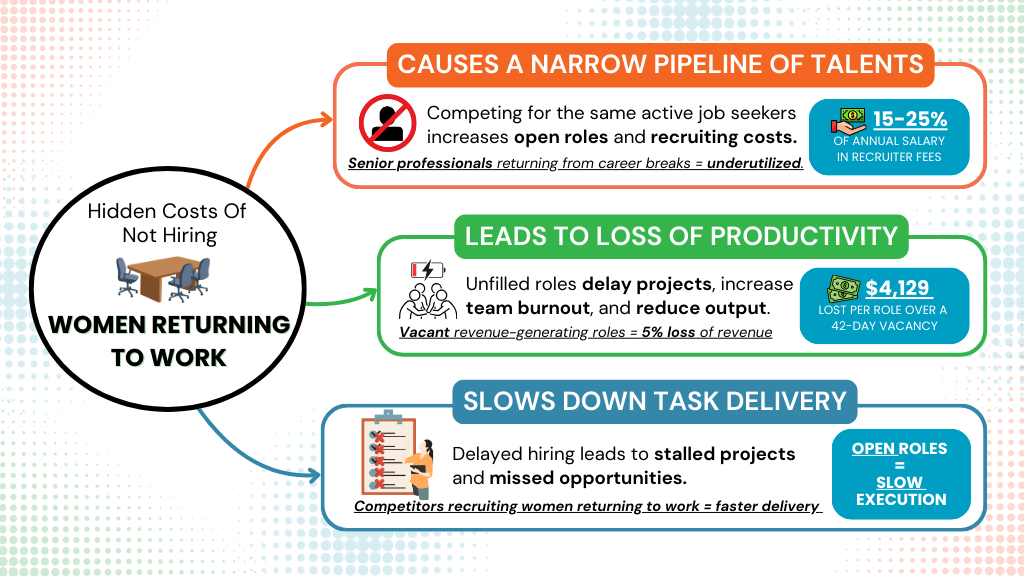
Every month that a role stays unfilled costs you in lost productivity, delayed projects, and team burnout. Unfilled positions are estimated to cost companies an average of $4,129 over a 42-day vacancy period. The cost skyrockets when the open positions are for revenue-generating roles. Other research has found that leaving key sales roles vacant can reduce a company’s entire revenue by 5% or more.
2. Makes You Deal with Narrow Pipeline of Talents
When you're competing for the same limited pool of active job seekers with every other employer in York Region, roles stay open even longer. Recruiter fees at 15-25% of annual salary compound when you cycle through multiple searches. Meanwhile, experienced professionals who've taken career breaks aren't being actively recruited by most agencies—less competition means potentially faster hires.
3. Impacts Delivery of Tasks
There's also the competitive disadvantage. Projects get delayed because you don't have the people to execute them. Your competitors who are recruiting women returning to work are moving faster.
The calculation is straightforward: every qualified candidate pool you overlook makes hiring harder and more expensive. Expanding your search to include women returning from career breaks isn't just about inclusion—it's strategically smart.
When Career Gaps of Returners Signal Strength, Not Weakness
When people see a gap on a resume, the first reaction is often to wonder what’s missing. But time away from work can build skills that a straight, uninterrupted career never does.
Take someone who stepped away for five years to care for aging parents while navigating Canada’s healthcare and social services systems. That experience demands serious crisis management under constant pressure. You’re coordinating multiple providers, pushing through bureaucracy, juggling complex schedules, and making high-stakes decisions without perfect information. Those are the same skills you want in a strong operations manager or client services lead.
Or think about someone who immigrated to Canada and spent a couple of years getting established before returning to their field. They’ve shown real adaptability. Learning a new language, figuring out unfamiliar systems, building a professional network from scratch, and taking big personal risks all require comfort with ambiguity and change. That’s exactly the mindset you want in someone who can work across cultures and deliver results in shifting conditions.
Career breaks for health reasons tell a different but equally important story. They show self-awareness and the ability to set boundaries, which matter more and more as burnout becomes common. They also point to resilience, persistence, and a clear understanding of personal limits and strengths.
So the better question isn’t “Why is there a gap?” It’s “What did you learn during that time that makes you stronger now?”
When you look at career breaks this way, they stop being red flags. Instead, they become signs of transferable skills and lived experience that many other candidates simply don’t have. That shift can widen your candidate pool and surface people with genuinely different strengths.